

A breakdown rarely starts when the equipment finally stops working.
The problem usually begins earlier.
A scheduled maintenance visit gets pushed back. A recurring service is missed. A technician notices something unusual but the finding stays buried in a WhatsApp conversation. A paper service report gets filed away without being connected to the asset’s previous history.
The equipment keeps running — until it doesn’t.
For businesses that depend on equipment being operational, the cost of a breakdown goes beyond the repair itself. There may be emergency technician call-outs, replacement parts, overtime, SLA pressure, customer disruption and lost productivity while the asset is unavailable.
This is why preventive maintenance matters.
Preventive maintenance is about keeping assets productive before small issues become costly downtime.
But as service businesses take on more customers, assets and technicians, managing preventive maintenance through Excel, WhatsApp, phone calls and paper records becomes increasingly difficult.
That is where preventive maintenance software comes in.
Key Summary
- Preventive maintenance software helps keep equipment running: Without a reliable way to track recurring maintenance, servicing can be missed, increasing the risk of unexpected breakdowns and downtime.
- Better maintenance means less costly downtime: By identifying and addressing issues earlier, businesses can reduce avoidable breakdowns, emergency repairs and disruption to customers.
- Connected maintenance operations improve profitability: With schedules, technician updates, service records and asset histories in one place, teams spend less time coordinating work and more time keeping assets productive.
What Happens When Preventive Maintenance Is Missed?
A missed maintenance visit does not necessarily cause an immediate breakdown.
That is what makes preventive maintenance easy to overlook.
Equipment can continue operating while components wear down, performance deteriorates or small problems become progressively worse. By the time the problem becomes obvious, the business may be dealing with an emergency instead of a planned maintenance visit.
The chain can look like this:
Missed maintenance → Issue goes unnoticed → Equipment deteriorates → Breakdown → Emergency repair → Downtime
And downtime can be expensive.
For a building operator, a faulty HVAC system can disrupt occupants. For a manufacturer, an unavailable machine can interrupt production. For an elevator service company, a lift breakdown can trigger an emergency response while technicians are pulled away from scheduled preventive maintenance.
The impact is not limited to the asset itself.
Emergency work can disrupt technician schedules, increase overtime and travel costs, require urgent parts and put pressure on customer SLAs. When the same equipment keeps breaking down, service teams may also find themselves spending time repeatedly fixing symptoms instead of addressing the underlying problem.
Preventive maintenance cannot eliminate every unexpected failure.
Its purpose is to make sure planned maintenance is not the thing that gets overlooked and to give teams better visibility into issues before they become larger operational problems.
Why Is Preventive Maintenance So Difficult to Manage?
For a small service operation, preventive maintenance may be as simple as keeping a spreadsheet of assets and their next service dates.
As a business takes on more customers and equipment, there are more schedules to coordinate, more technicians to assign and more service records to maintain.
A typical workflow can quickly become:
Excel schedule → WhatsApp technician → Paper checklist → Photos in WhatsApp → Admin compiles report → Spreadsheet updated
Every step may work individually.
The problem is that none of them are properly connected.
The maintenance schedule may show that a service is due, but the operations team may not know whether the technician has actually completed it.
The technician may have taken photos of a problem, but those photos could be sitting in a WhatsApp conversation.
The service report may have been completed, but the asset’s previous maintenance history could still be stored somewhere else.
This is a fragmented workflow, where preventive maintenance schedules were managed in Excel, service reports were handwritten and technician updates, photos and videos were shared through WhatsApp before being manually compiled into customer reports.
The result is more than administrative inconvenience.
When maintenance information is fragmented, it becomes harder to see what is overdue, what has been completed and which assets may need attention.
And when visibility drops, the operation becomes more reactive.
How Does Preventive Maintenance Software Help?
Preventive maintenance software connects the maintenance process from planning through to completion.
Instead of relying on separate tools, the workflow becomes:
Plan → Schedule → Execute → Record → Monitor
The important difference is not simply having a digital maintenance calendar.
It is having the maintenance schedule connected to what actually happens in the field.
Schedule maintenance before it becomes urgent
Recurring maintenance plans can be created for assets based on their required service intervals.
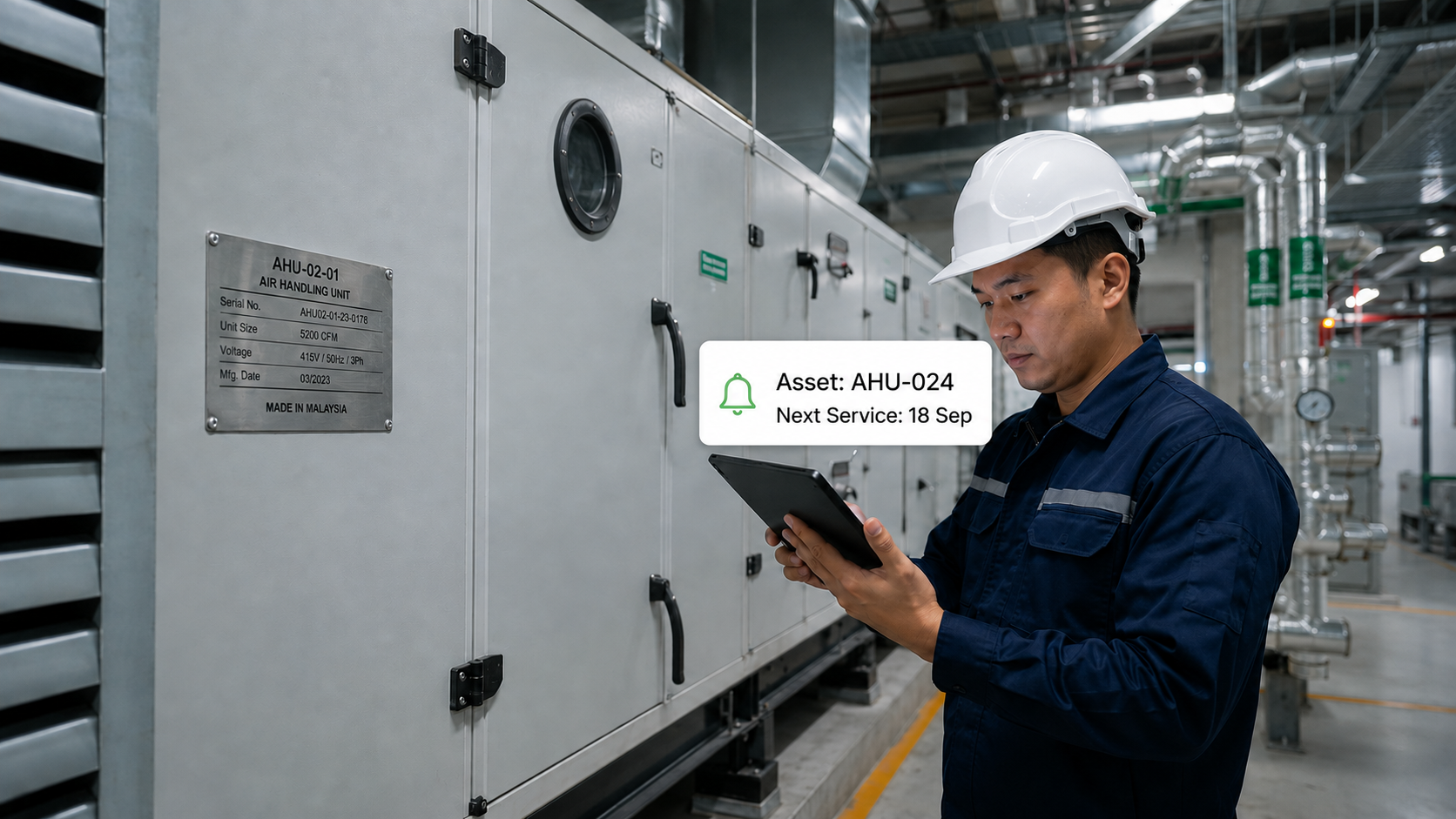
Upcoming work is visible to the operations team, while automated reminders help prevent scheduled maintenance from being forgotten.
This becomes increasingly important when teams manage hundreds or thousands of assets, each with different maintenance schedules and customer commitments.
The goal is simple:
Make it harder for scheduled maintenance to be missed.
Give technicians a clear process to follow
A schedule tells a technician when to visit.
A digital SOP or checklist helps determine what needs to be done.
Instead of relying on individual technicians to remember every maintenance step, businesses can standardise procedures within the workflow.
Technicians can follow the same required process across different customer sites, branches and assets.
This helps reduce inconsistent execution and gives managers greater confidence that scheduled maintenance is being performed according to the required process.
Capture what happened during the visit
Maintenance is not complete simply because a technician was dispatched.
The business needs to know what was checked, what was found and what was done.
Technicians can capture information such as:
- Checklist results
- Photos and videos
- Technician findings
- Customer signatures
- Customer feedback
- Service notes
The information becomes part of the job record instead of being scattered across paper forms and messaging conversations.
Build a complete asset history
Every maintenance visit adds another piece of information about an asset.
Over time, these records create a history of:
Maintenance → Findings → Repairs → Breakdowns → Inspections → Service performance
This gives technicians and managers more context when an issue occurs.
If an asset repeatedly experiences the same problem or requires frequent repairs, the team can see that pattern instead of treating every breakdown as an isolated incident.
That makes the maintenance history useful for more than documentation.
It helps teams make better decisions about the assets they are responsible for keeping operational.
How Does Preventive Maintenance Increase Equipment Uptime?
The connection between preventive maintenance and uptime is straightforward:
Consistent maintenance → Earlier issue detection → Fewer avoidable failures → Less downtime → Higher uptime
Preventive maintenance software does not prevent mechanical failure by itself.
What it does is make the maintenance operation more reliable.
Scheduled work is easier to track. Maintenance procedures are easier to standardise. Findings are easier to record. Asset histories are easier to access.
Together, these give teams a better opportunity to act before maintenance issues become operational disruptions.
This matters because equipment uptime has a business value.
An asset that is available and functioning can continue supporting production, building operations, customer services or revenue-generating activities.
An asset sitting idle because of an avoidable breakdown cannot.
For service businesses, this is why preventive maintenance should not be viewed simply as an administrative requirement.
It is a way to protect the productive time of the assets they maintain.
Preventive Maintenance Software vs Excel, WhatsApp and Paper

The difference is not simply about replacing old tools with new ones.
It is about connecting the workflow.
| Traditional approach | Connected maintenance approach |
| Maintenance schedules in Excel | Recurring maintenance schedules |
| Manual reminders | Automated reminders set once |
| Technician updates through WhatsApp | Real-time job updates |
| Paper checklists | Digital SOPs and checklists |
| Photos stored in conversations | Photos attached to service records |
| Manual report compilation | Digital service reports |
| Fragmented asset records | Centralised asset histories |
| Manual follow-ups | Real-time maintenance visibility |
A maintenance calendar alone does not solve the problem.
You may know that a lift is due for servicing next week, but that does not tell you whether the right technician has been assigned, whether the maintenance was completed, what the technician found or whether the service report has been submitted.
The real value comes from connecting the entire maintenance workflow.
Schedule the work → Assign the technician → Complete the maintenance → Capture proof → Generate the report → Update the asset history
When these steps are connected, teams have greater visibility into what has been completed, what is overdue and what needs attention next.
Instead of adding another system for scheduling, businesses can create a connected maintenance process that follows the job from the office to the field and back again.
How Does Preventive Maintenance Software Improve Profitability?
The financial impact of preventive maintenance is not always found in one obvious line item.
It comes from preventing operational problems from becoming more expensive than they need to be.
Consider the difference between:
Planned maintenance
Scheduled technician → Planned service → Early issue identified → Controlled repair
and:
Reactive maintenance
Unexpected failure → Emergency dispatch → Urgent repair → Equipment downtime → Customer disruption
Reactive maintenance can require more urgent resources and create disruption that planned maintenance is designed to avoid.
There is also the hidden cost of coordination.
When teams rely on phone calls, WhatsApp messages and spreadsheets to manage maintenance, managers and administrators spend time chasing updates, rescheduling technicians and compiling service information.
That time has an operational cost.
A connected maintenance operation can reduce some of this manual coordination while giving managers greater visibility into what needs attention.
The business impact becomes:
Higher uptime + fewer avoidable breakdowns + less reactive work = better control over operating costs
For service businesses, that ultimately means protecting the productivity of the assets they maintain and the recurring revenue associated with those customer relationships.
Why Does Preventive Maintenance Become Harder as Your Business Grows?
The maintenance procedure itself does not necessarily become more complicated.
The coordination does.
A growing service company may manage hundreds of customer assets across offices, condominiums, hospitals, shopping malls, factories and other sites.
Each asset can have its own:
- Preventive maintenance schedule
- Service history
- Technician requirements
- Inspection requirements
- Customer SLA
- Breakdown history
- Documentation
At the same time, technicians may need to respond to emergency breakdowns while scheduled preventive maintenance continues.
One emergency job can affect several scheduled appointments.
A technician gets diverted.
Another technician needs to be reassigned.
A customer needs to be informed.
The preventive maintenance visit needs to be rescheduled.
If all of this is managed manually, every change creates more coordination work.
This is where operational visibility becomes important.
Managers need to know not just what is scheduled, but what is actually happening.
Which preventive maintenance jobs are completed?
Which are overdue?
Which technicians are occupied?
Which assets have recurring breakdowns?
Which customer commitments are at risk?
Without a connected view, answering these questions often means contacting several people and checking several systems.
As operations grow, that approach becomes harder to sustain.
What Should You Look for in Preventive Maintenance Software?
If you are evaluating preventive maintenance software, focus less on the number of features and more on whether it can support the way your maintenance operation actually works.
1. Recurring maintenance scheduling
Can the system automatically manage recurring maintenance instead of requiring someone to manually check a spreadsheet?
2. Mobile field execution
Can technicians receive jobs, update progress and complete maintenance directly from their phones?
This matters because preventive maintenance happens in the field, not behind a desk. If the system is difficult to use, technicians may delay updates, skip digital processes or continue relying on familiar tools such as WhatsApp and paper forms.
A good preventive maintenance system should make it simple for technicians to access their jobs, follow the required maintenance process and record what happened while they are still on site.
3. Digital SOPs and checklists
Can you standardise how maintenance is performed and make required steps visible to technicians?
4. Service proof and reporting
Can technicians capture photos, videos, findings and customer signatures and generate a service report without returning to the office?
5. Complete asset history
Can managers and technicians see previous maintenance, breakdowns, inspections and service records for an asset?
6. Real-time visibility
Can operations managers see what has been completed, what is overdue and what is happening in the field without manually calling multiple people?
These capabilities matter because preventive maintenance is ultimately about execution and visibility, not simply scheduling.
How Caction Helps Service Businesses Stay Ahead of Breakdowns
Caction connects preventive maintenance planning with the work technicians perform in the field.
Teams can create recurring preventive maintenance schedules, assign technicians, manage digital SOPs and checklists, capture photos and videos, collect customer signatures and generate service reports directly from the field.
These activities are connected to the relevant asset and its service history.
Instead of:
Excel + WhatsApp + Paper
the workflow becomes:
Schedule → Assign → Execute → Capture → Report → Track
Managers gain visibility into maintenance progress without relying on multiple manual follow-ups.
Technicians spend less time on paperwork and can access the information they need directly from the field.
Service records are captured as part of the maintenance process instead of being compiled later from different sources.
A connected maintenance workflow brings scheduling, technician updates, service reports and asset history into one process.
The goal is not just to digitise maintenance, but to connect what is scheduled, what is done and what is recorded.
The result is a maintenance operation that is easier to control, easier to scale and better positioned to keep customer assets productive.
Preventive Maintenance Is About More Than Maintenance
The goal of preventive maintenance is not simply to complete more checklists.
It is to keep equipment available for the people and businesses that depend on it.
When maintenance is missed, small problems can become breakdowns.
When breakdowns happen, uptime suffers.
And when uptime suffers, businesses can face higher costs, disrupted operations and unhappy customers.
Preventive maintenance software helps close the gap between what should happen and what actually happens in the field.
By connecting maintenance schedules, technicians, service execution, asset histories and operational visibility, businesses can move away from constantly reacting to breakdowns and towards a more proactive way of managing their assets.
Better maintenance protects uptime. Better uptime protects profitability.
Frequently Asked Questions
What is preventive maintenance software?
Preventive maintenance software helps businesses plan, schedule, execute and monitor recurring maintenance before equipment fails. It typically connects maintenance schedules, technician assignments, checklists, service reports and asset histories in one system.
How does preventive maintenance software prevent breakdowns?
It helps teams keep recurring maintenance on schedule, standardise maintenance procedures and maintain complete service histories. This makes it easier to identify and address maintenance issues before they become larger problems, although no software can eliminate every unexpected breakdown.
How does preventive maintenance increase uptime?
Preventive maintenance helps keep equipment serviced and operating as intended, reducing the risk of avoidable failures and unplanned downtime. Software makes this process easier to manage by keeping scheduled maintenance, overdue work and asset histories visible.
What happens if preventive maintenance is missed?
A missed maintenance activity can allow wear or developing problems to go unnoticed. Over time, this may increase the risk of equipment failure, emergency repairs and unplanned downtime.
Can preventive maintenance software replace Excel?
It can replace many spreadsheet-based maintenance workflows by centralising recurring schedules, job updates and asset histories. The main advantage is that maintenance information becomes connected rather than being manually maintained across separate spreadsheets.
Can technicians use preventive maintenance software on mobile?
Yes. Field-focused preventive maintenance software can allow technicians to receive jobs, complete digital checklists, capture photos and findings, update job status and submit service reports directly from customer sites.
What should preventive maintenance software include?
Key capabilities include recurring maintenance scheduling, automated reminders, mobile field access, digital SOPs and checklists, service documentation, asset histories and real-time operational visibility.
How does preventive maintenance software reduce administrative work?
Instead of technicians submitting information through paper forms, WhatsApp and separate systems, they can capture job updates, checklists, photos, signatures and findings directly in the field. This reduces the need for administrators to manually compile service information into reports.
Is preventive maintenance software the same as CMMS?
Not necessarily. A CMMS primarily focuses on maintenance management, while field service-oriented preventive maintenance software can connect maintenance scheduling with technician dispatch, mobile execution, customer reporting and wider service operations.


Leave a Reply